

A KakaoTalk alert that signals that a message has arrived.
Endless YouTube Shorts you keep watching.
A modern person’s day is packed with stimuli.
Within all of that, “taking care of your mind” starts to feel like a distant story.
You’ve probably decided to try meditation more than once—but the truth is, when it comes time to start, it’s hard to know where to put your hands first.
A concrete practice book has been released that can help solve that confusion.
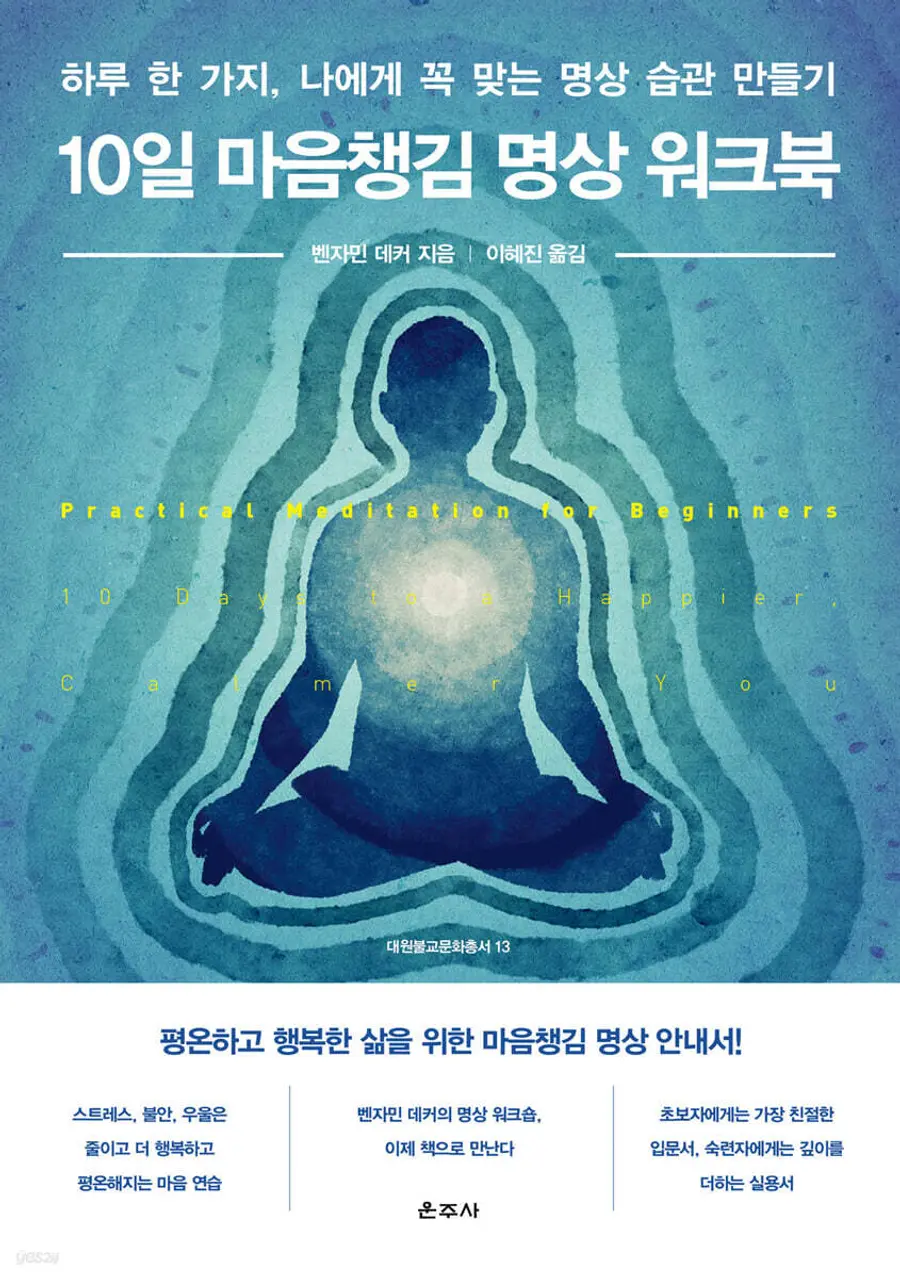
It’s 『10-Day Mindfulness Meditation Workbook』 by Benjamin W. Decker (translated by Lee Hye-jin, Unjusa, 184 pages, 15,800 won).
Published as the 13th volume in the Daewon Buddhist Culture Series, this book gives everyone who wants to enter meditation through practice rather than theory a sufficiently short—yet sufficiently focused—ten-day time to call your own.
“Meditation isn’t something you know—it’s something you do.”
Author Benjamin W. Decker is a world-renowned meditation teacher and bestselling author based in Los Angeles. As a founding leader of “Unplug Meditation,” a pioneer of a modern meditation studio, and of the global wellness brand “Wonderlust,” he has also been featured in 《The New York Times》 and 《Forbes》.
What he emphasizes first in this book is a simple yet weighty principle: meditation is “practice,” not “theory.” Only by learning it with your body and sensing it with your mind does it truly become yours. From beginning to end, this book places “do it yourself” at its center. Instead of long, philosophical explanations about meditation, it guides you to experience ten meditation techniques—one per day—directly.
Each meditation method includes its meaning and effects, what you’ll need, step-by-step ways to practice, deeper guidance for going further, and a workbook format where you can record your own experiences firsthand. It’s designed not just for copying along, but for helping you observe and record your inner world yourself—so you become the subject of your practice.
Where Eastern wisdom meets modern neuroscience
The reason Decker’s meditation methods are special is that they’re not confined to any particular religion or tradition. Having broadly studied and practiced training methods from Buddhism and Hinduism, as well as Jewish, Christian, and Islamic traditions and those from many different cultures, he gently unpacks that wisdom in the language of modern people.
Then come the latest neuroscience findings. Research results woven throughout the book show that meditation physically changes the brain and activates areas related to learning, cognition, memory, and emotion regulation—contributing in practical ways to stress reduction, lower blood pressure, and increased happiness. It convincingly shows that meditation is not a mysterious spiritual experience, but a life skill training proven by science.
Lowering the barrier to meditation — for beginners and seasoned practitioners alike
The greatest virtue of this book is that the entry barrier is low. With a quiet space, a chair or cushion, a small notebook, and about ten minutes a day, anyone can start right away. No special preparation, no special posture, and no special beliefs are required.
For those encountering meditation for the first time, it becomes a friendly introduction. For those who already have experience practicing, it serves as a practical guide that explores new techniques and brings renewed energy and inspiration to their practice. Designed systematically so you can build focus, attention, awareness, and self-regulation abilities in a short time, this program offers especially realistic and sustainable methodology for busy modern people.
The translator, Professor Lee Hye-jin, earned her PhD in clinical psychology in Madison, Wisconsin (USA), under the guidance of Professor Richard Davidson, a pioneer in the science of meditation. She is currently serving as a professor in the Department of Psychology at Chonnam National University, where she studies the effects of mindfulness. By preserving the warmth and practicality of the original text, the translation enhances the book’s completeness.
It’s okay if you’re not perfect—starting again is practice
What the author repeatedly emphasizes throughout the book is the “mind of a beginner.” An open attitude that accepts new practice without judging or evaluating it. You don’t need to blame yourself on a day when meditation doesn’t go well—or if you can’t fill all ten days. The process of continuing again itself is already practice.
Ten days is short. But the seeds planted within it last a long time. A brief experience of paying attention to your breath, and those moments piling up as you walk and feel the sensations in the soles of your feet—gradually change how you approach life. Meditation isn’t something you do only in mountain monasteries or quiet temples. In this very moment, it begins with noticing your breath.