

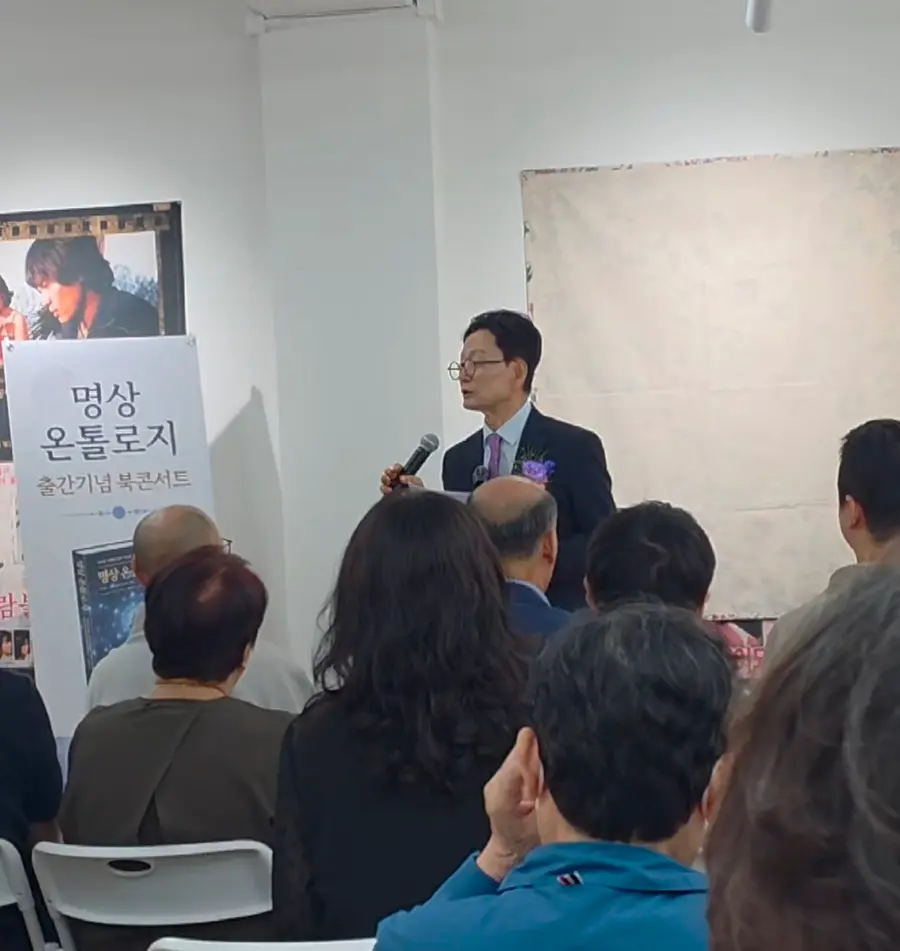
An old saying holds that “if you hear the Way in the morning, you can die content that evening.” Jung Soon-il, professor emeritus at Wonkwang University, has carried that saying as a lifelong question. He studied Won Buddhism at Wonkwang University, earned a doctorate in Buddhist studies at the university’s graduate school and later worked as a postdoctoral researcher in the Department of Indian Philosophy at the University of Tokyo. After returning to his alma mater, he served as director of the Jeongyeok Institute and dean of the Graduate School of Oriental Studies. For many years, he trained tea experts and meditation specialists.
Recently, he published a hefty 656-page book titled Meditation Ontology. At a recent book concert, he spoke calmly—and at times with a touch of humor—about how long he wandered before completing the volume.
20 years to finalize the table of contents, 33 drafts in print
Professor Jung said he had sought out and studied under various teachers since his youth. In the 1980s, he even met the ascetic Muhak. Yet the knots in his mind did not easily come undone. After spending his life organizing materials and building systems, he found meditation to be one realm that stubbornly resisted organization.
It took 20 years, he said, just to settle on the table of contents for Meditation Ontology. Each time he produced a new version, he printed it out. The table of contents in the published book is his 33rd draft, he said. The inner insights and experiences of energy that came to him later in life did not arrive in sequence. He explained that the book emerged from organizing those scattered, back-and-forth experiences and providing them with a theoretical foundation. As he walked the audience through each of the 33 versions, his voice carried the quiet composure of someone describing something long kept in reserve.
Why “ontology”?
Ontology is originally a philosophical term. Of the major branches of philosophy—ontology, epistemology and axiology—it refers to the study of being and belongs to the realm of metaphysics. In recent years, however, the word has drawn attention in another field: artificial intelligence. Scholars use “ontology” to describe efforts to integrate fragmented algorithms and information into a single structure of meaning.
Professor Jung recalled that a colleague who studies AI ontology was pleasantly surprised when he said he had titled the book Meditation Ontology. The task he undertook in the book is similar. Each meditation teacher presents his or her own method as the best, and most teach people how to meditate—how to close their eyes and how to breathe. But, Jung noted, they rarely explain why people should meditate. This book begins with that why.
Putting the universe—not the mind—at the starting point of meditation
Professor Jung’s vision is expansive. The universe began with the Big Bang and will eventually converge into a single whole. The tiniest world and the vast cosmos, he argues, are fundamentally one body. He describes human beings as microcosms and meditation as the work of bringing human life, the microcosm, into harmony with the breath of the macrocosm.
Building on that theoretical framework, he said he organized cosmic emergence into four stages. He then added eight stages of reductive meditation and two stages of manifestation meditation as corresponding practices, creating a 16-stage system in all. Some people who read the book in advance said it was like seeing a path emerge through the fog, while others worried about whether it was wise to reveal so much, he said. Jung replied that, in the age of AI, he had decided it was necessary to make this much public.
“Meditation is civilization’s last relief pitcher”
During the question-and-answer session, an audience member asked what meditation means in an era when AI appears to be making people more alike. Jung’s answer was grave. The era has arrived in which AI can create an even more capable AI on its own, he said, and humanity could face a crisis within 10 years if the trend continues.
Humans could lose control over superintelligence, he said, and the consequences could be greater than a climate disaster. In such circumstances, he declared, meditation is civilization’s last relief pitcher. The room grew noticeably heavier at that point.
Asked whether people can achieve enlightenment without spiritual practice, he offered three possibilities. Someone who accumulated extensive practice in a past life may awaken in an instant; someone who endures many cycles of reincarnation may eventually arrive there; and meditation is a shortcut that reduces the time and suffering involved. He compared it to shortening the length of mandatory military service, prompting laughter from the audience.
Asked how to distinguish wholehearted effort from attachment, he gave an unexpectedly straightforward answer. Meditation, too, can become an addiction. If not meditating makes someone anxious, he said, that condition is no different from an addiction to alcohol or cigarettes. Dedication is necessary, he added, but people must first examine whether that drive comes from anxiety.
The next gathering continues at Center One in November
Asked how best to read the book, Professor Jung said he had already provided the answer in the introduction. Just as a dog walking along a country road without a leash bounds over steppingstones, readers should not stop to wrestle with unfamiliar Buddhist terms; they should simply keep going to the end. When they return to the book later, he said, their eyes may open to its meaning. Asked about plans for a translation, he also shared that a young researcher had already volunteered to prepare a first English translation.
The book concert has ended, but the conversation will continue. Beginning Nov. 3, a six-week hybrid course on Meditation Ontology will be held every Tuesday at 7 p.m. at Center One of the Meditation Leadership Society in Haebangchon, Yongsan-gu, Seoul.
It is a chance to hear directly the story behind the 33-times-revised table of contents. Even after leaving, I continued to think about Jung’s words for some time: bringing my breathing into rhythm with the breath of the universe.