

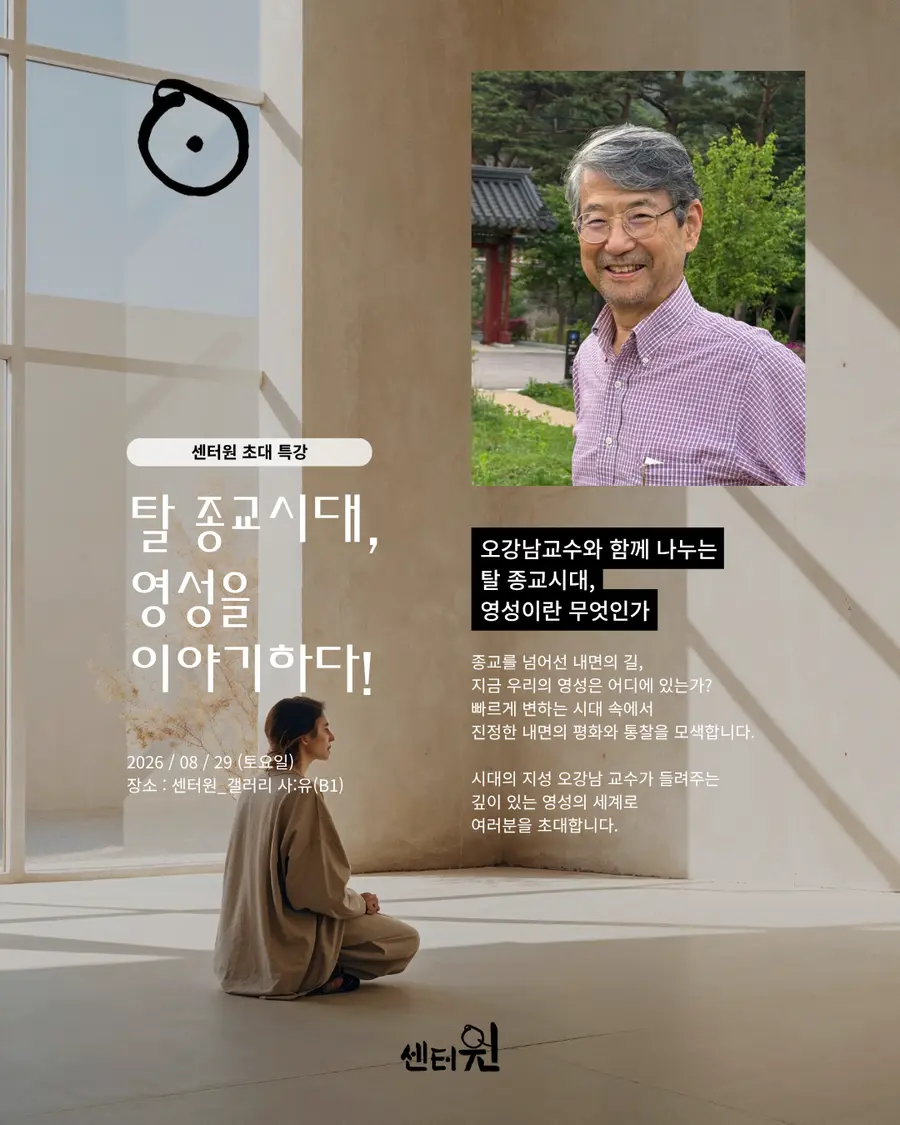
Fewer people are leaving religion behind, but the questions haven’t vanished. Who am I? Where is this life headed? Those questions still remain in each person’s own place, regardless of the threshold of a church or a temple. A new event will provide a chance to bring those questions back—not under the name “religion,” but under the name “spirituality.”
Leadership Meditation Society Center One will invite Professor Oh Kang-nam, a comparative religion scholar from Regina University in Canada, for a special lecture on Aug. 29 at 3:00 p.m. The lecture, titled “Beyond the Religious Era: Talking About Spirituality,” will be held at the Center One basement level 1, Gallery Sa:yü in Haebangchon, Yongsan-gu, Seoul. The talk runs for 90 minutes, ending at 4:30 p.m.
The 40% Believers Era: The Questions of “Spirituality” Remain
A survey by Gallup Korea of 7,647 people aged 19 and older nationwide from March to November 2025 found that 40% said they currently believe in a religion, while 60% said they do not. In their 20s, the share of religious people was just 24%. The share of religious people has steadily declined from 54% in 2004, and over the three years since 2022 it has fallen below 40%.
The numbers point to a retreat in religion, but during the same period the number of people seeking temple stays, meditation programs, and mindfulness apps has actually increased. It’s a shift toward experiences rather than institutions and toward self-understanding rather than affiliation. This special lecture starts by asking how to read that gap.
From the Surface to the Depth: The Key Questions Professor Oh Kang-nam Has Raised
Professor Oh Kang-nam is widely regarded as a leading comparative religion scholar in South Korea. He graduated from the Department of Religious Studies at Seoul National University and its graduate school, then earned a Ph.D. in religious studies at McMaster University in Canada for research into Huayan’s theory of interdependent arising. He taught comparative religion at the University of Regina in Canada for 27 years and is currently an emeritus professor there. He served as president of the North American Association of Korean Religious Studies and as co-chair of the Korean Religion Division of the American Academy of Religion. He continues writing and lecturing while traveling between North America and South Korea.
A Lens That Distinguishes Two Layers of Religion
The concept Professor Oh has held onto for a long time is “surface religion” and “deep religion.” According to his explanation, surface religion is the kind of religion people believe in to do well in the present self. It is characterized by unconditional belief and an attitude of clinging to the literal text of scriptures. By contrast, deep religion looks inward to find the true self and seeks to see through what lies behind the letters beyond the text. His distinction is that instead of searching for an absolute being only outside, it also looks within—and it emphasizes joy “right here, right now” more than hopes for the afterlife.
Professor Oh has said that almost all religious people begin from the surface, but that at some point they must deepen into the deep layer. This isn’t a yardstick for criticizing any specific religion. Rather, it is close to a question that asks what religion was originally meant to do.
From “There Is No Jesus” to “Religion, Again: Realization”—
His books include “There Is No Jesus,” which directly addresses faith trapped in literalism, as well as “World Religions at a Glance” “Religions, See the Depth” and “Buddhism, Read as a Neighboring Religion,” and “Professor Oh Kang-nam’s Thoughts.” He also handled “The Tao Te Ching,” which 풀이es Nožang philosophy, and “Zhuangzi,” along with the commentary book on the Gospel of Thomas, “The Secret Teachings of the Living Jesus.” Several translations are also available, including Thich Nhat Hanh’s “Living Buddha, Living Jesus” and Kahlil Gibran’s “The Prophet,” among others.
In May of this year, together with Sung Haeyoung, a religion and psychology scholar and professor in the Department of Religious Studies at Seoul National University, he published “Religion, Again: Realization.” It is a revised and expanded edition of “Religion, Now: Realization,” originally published in 2011, updated after 15 years, and it delivers a bold argument that in the age of artificial intelligence, religion must return to the seat of realization. It is the most recent work closest to the question driving this special lecture.
For detailed registration and payment instructions, check the Center One KakaoTalk channel.
https://pf.kakao.com/_fcdxcG/114240475