

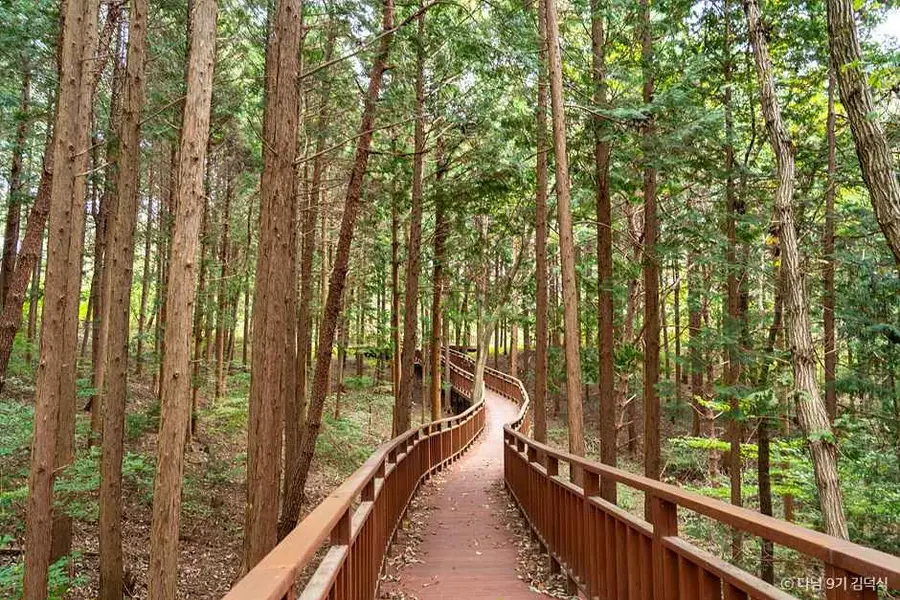
Once you step into the woods, the sound changes first. At Chukryeongsan in Jeollanam-do, the Korean cypress forest is so dense with trees that outside noise fades within just a few steps. The ground gives way under your feet, softened by long-accumulated fallen leaves, while shafts of light fall vertically between straight-standing trunks. People who walk through this forest say their words usually grow fewer. It is a place where breathing naturally lengthens, even if you have not learned meditation separately.
This forest did not simply come into being. It is a man-made woodland created by one person who planted trees for more than 20 years.
Chunwon Im Jong-guk, poured in his private fortune for 21 years
The cypress forest at Chukryeongsan dates back to 1956. Mr Im Jong-guk, also known as Chunwon, began planting Korean cypress and cedar in a stripped, barren mountain and continued reforestation for 21 years. It was work he carried out with his own private funds.
The forest he left behind was dedicated in 2002 to the “Hall of Fame for Forests”, and in 2010, when the Korea Forest Service acquired the core areas as state-owned forest land, it took shape as a national healing forest. The total area is 1,148ha, of which state-owned forest accounts for 388ha. It is known that 2.5 million trees are growing there, combining Korean cypress and cedar.
〈Image: A panoramic view of a forest packed with cypress tree trunks (aerial or wide shot) — needs confirmation of photo: “Jangseong Cypress Forest Panorama” from Korea Forest Service publicity materials〉
More than half a century passed from the start of a forest in one man’s hands to its becoming a healing space managed by the state. Knowing that story and walking without knowing it are different, even along the same path.
10.2km laid out across six branches
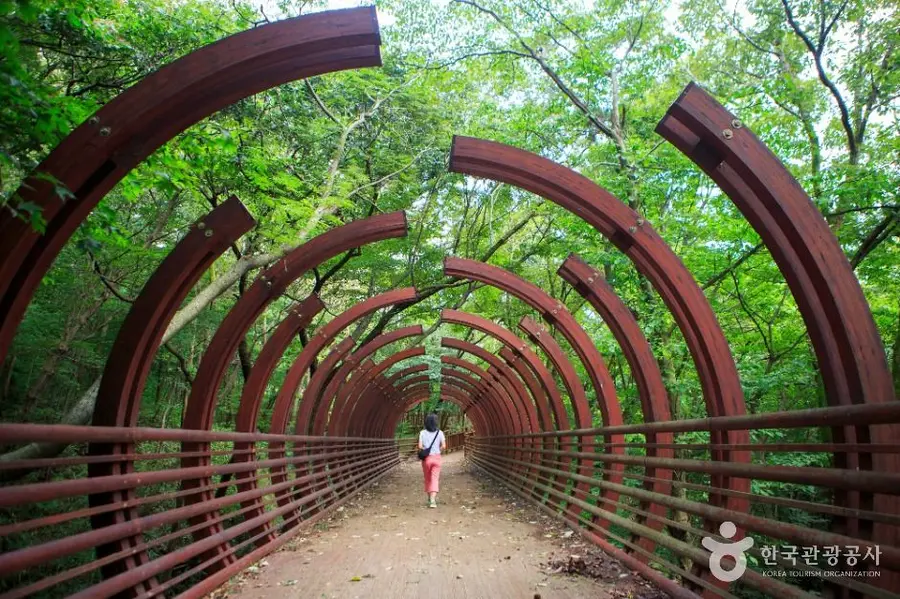
All the forest paths are split into six themes, making a total of 10.2km. They are given names such as the Oxygen Forest Trail, Sky Forest Trail, and Barefoot Forest Trail. Each course has different gradients and surfaces, so visitors can choose according to their fitness and purpose.
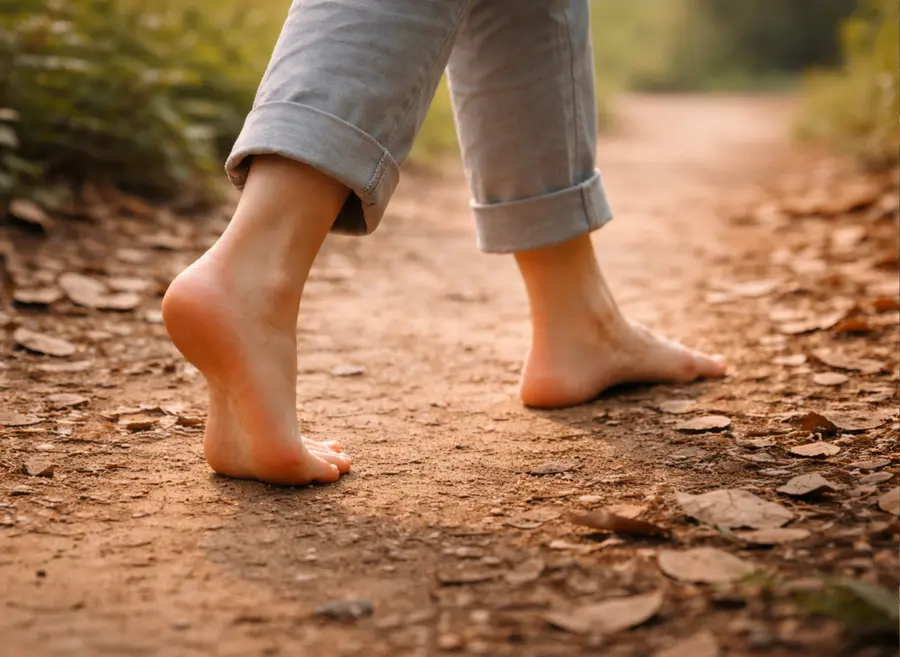
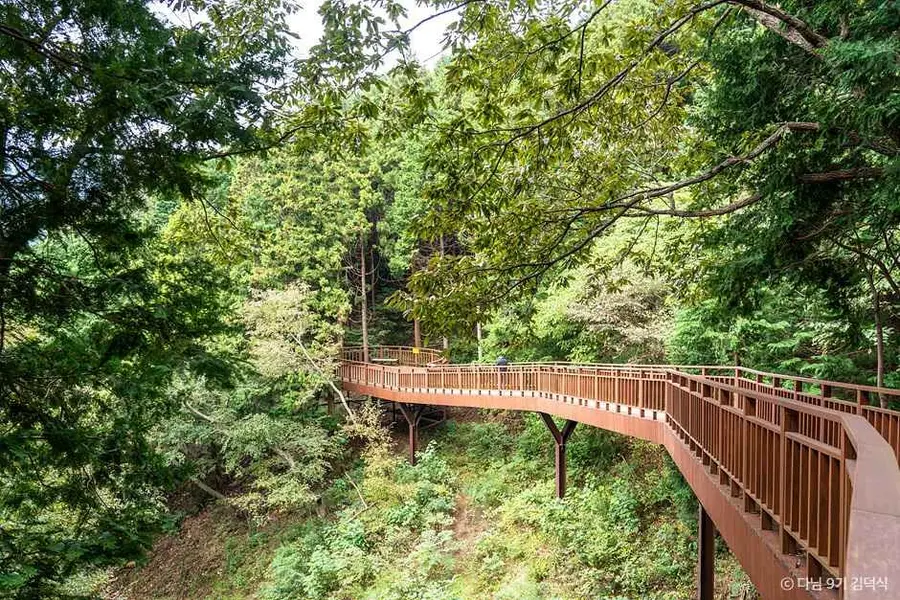
The Barefoot Forest Trail is, as its name suggests, a section designed for walking without shoes. Walking, which lets the textures of soil and fallen leaves register directly under your soles, is a way of holding the present moment in place, and it connects naturally with walking meditation. The Sky Forest Trail opens your gaze upwards; you end up looking for a long time at the tree tops and the sky visible between them.
It is not just for walking — forest therapy programme
At the National Jangseong Healing Forest, paid programmes run by forest therapy guides are also held. They include time lying back on a hammock and letting your body sway between the trees, meditation focusing on breathing and sensations, and activities that wake up your five senses one by one.
The composition, timing and fees of the programmes vary depending on the season. Before visiting, it is best to check the operating schedule and remaining places on the Korea Forest Service’s integrated booking system, “Forest e-rang” (sooperang.go.kr), and make a reservation. Programmes are offered not only for individuals but also for group bookings.
What it means to spend time in the forest
Forest therapy refers to activities that use the forest environment to look after physical and mental health. In an environment where the scent released by trees, the textures of soil and leaves, and the feel of light and sound all reach the senses at once, people return to this moment more easily than usual.
One reason the Chukryeongsan cypress forest fits meditation so well lies in the terrain and the arrangement of the trees. Korean cypress grow straight and their branches cluster high up, which opens up views of the lower area. Even when you cast your eyes far away, there is little that interrupts you, and sounds scatter between tree trunks. That is the backdrop that creates a sense of space that does not feel stifling even after sitting for a long time.
A trip that takes the forest as its destination differs in rhythm from a journey aimed at checking out sights. What remains is not how many places you visited, but how slowly you walked. Spending two hours on a single course suits this forest better than rushing through six courses.
When is the best time to go?
The time of day most people choosing the cypress forest name is the morning. Between 9am and 11am, the forest air is said to be at its best, drawing visitors to that window. Arriving early in the day and walking from the quieter sections is also an option.
In terms of seasons, every time of year is different. Korean cypress and cedar are evergreen trees, so the forest’s density is maintained even in winter. In summer, temperatures under the tree shade are lower than outside, making walking pleasant, and the day after rain brings stronger smells of soil and of trees.
Visitor information
- Address: 778 Chukryeong-ro, Seosam-myeon, Jangseong-gun, Jeollanam-do
- Entry fee and parking fee: Free
- Visitor centre hours: Until 5pm in winter, until 6pm in summer (forest trails are open all year)
- Programme booking: Forest e-rang (sooperang.go.kr), the Korea Forest Service’s integrated reservation system
- What to bring: Comfortable shoes, spare socks (for the Barefoot Forest Trail), water, and a summer insect repellent
The forest trails themselves are open free of charge, so simply going for a stroll is enough for a good walk. If you want the forest therapy programmes, you need to book in advance.
30 minutes for those walking alone
There is plenty you can do in the forest without booking a programme. As you walk, choose a spot where there are fewer people, stop, then sit on a bench or a flat rock. Close your eyes and breathe slowly about ten times. After that, count the sounds you can hear one by one. The wind, the birds, footsteps coming from far away. The trick is to not judge the sounds at all, just let them pass through.
Sit for about ten minutes, then walk again. This time, you pay attention only to the sensation of your soles touching the ground. If your thoughts drift elsewhere, notice it and bring yourself back to your feet. This simple back-and-forth is the basic structure of meditation you do in the forest.
Courses that change depending on who you come with
If you are coming on your own, it is best to pick a single course during quieter hours and walk it both ways. You look ahead beforehand to find a place to sit in the middle, then you remain there on the return leg.
If you come with parents, it is better to choose a short stretch with a gentle gradient. Because the forest trails are covered with soil and fallen leaves, they may become slippery after rain. If you come with children, it is also an option to spend longer on the Barefoot Forest Trail. Feeling the ground with your feet is among the activities children enjoy the most.
What to observe in the forest is simple. Do not play music loudly, do not leave rubbish, and lower your voice near places where other visitors are sitting. Quiet is an asset of this forest, and protecting it creates the next visitor’s experience in turn.
A place among domestic wellness travel destinations
As the government sets out a plan to grow healing tourism into an industry, programmes using the forest have become one of the central pillars of wellness travel within the country. The Chukryeongsan cypress forest is among those, with the added story of an individual’s long history of planting. Seeing only the tree density and the completeness of the trails, versus knowing that one person planted there for 21 years, changes the weight of the visit.
It also offers conditions that make it easy to introduce to foreign visitors. It is open without an entry fee, the experience is created simply by walking, and the programme can be chosen only by those who want it. If you add multilingual guidance and meditation and yoga programmes on top, Jangseong can take one more step towards becoming a destination led by “walking meditation”.