

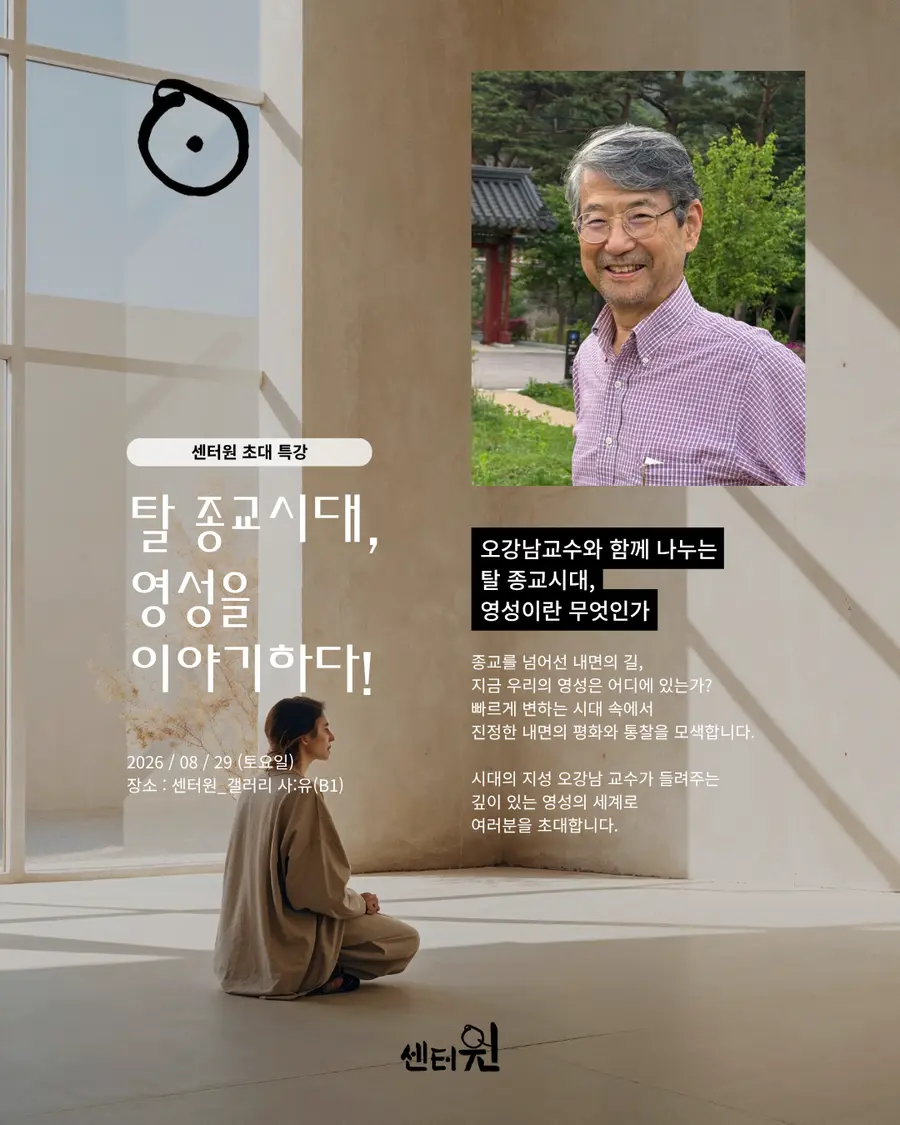
The number of people who have left religion has grown, but the questions have not disappeared. “Who am I?” and “Where is this life heading?” remain in their places, regardless of the thresholds of churches and temples. A gathering is being prepared to draw those questions back out—not under the name of religion, but under the name of spirituality.
Leadership Meditation Society Center One will hold an invited lecture on 29 August at 3pm, inviting Professor O Kang-nam, a comparative religion scholar and honorary professor in the Department of Religious Studies at the University of Regina in Canada, to deliver the talk “Post-Religion Era: Talking about Spirituality”. The venue is the Gallery Sa:yoo on the basement level (B1) of Center One in Haebangchon, Yongsan-gu, Seoul, and the lecture will run for 90 minutes, until 4.30pm.
The age of 40% believers: the question of spirituality remains
A survey by Gallup Korea, conducted from March to November 2025 of 7,647 people aged 19 and over nationwide, found that the share of people who said they currently have a religion was 40%, while those who said they do not have a religion was 60%. In their 20s, the proportion of believers was just 24%. The proportion of believers fell steadily from 54% in 2004, and for the three years since 2022 it has remained below 40%.
The figures point to religion’s decline, yet during the same period the number of people looking for temple stay programmes, meditation programmes and mindfulness apps has actually increased. It is a shift away from institutions and towards experience, away from affiliation and towards understanding oneself. This invited lecture starts from the question of how to read that gap.
From the surface to the depths: the topics Professor O Kang-nam has put on the table
Professor O Kang-nam is regarded as a leading comparative religion scholar in South Korea. He graduated from Seoul National University’s Department of Religious Studies and its graduate school, and received a PhD in religious studies from McMaster University in Canada for research into the concept of the “principle of interdependent arising” (fa-jie yan-qi) within Huayan. He taught comparative religion for 27 years at the University of Regina in Canada and is currently an emeritus professor at the same university. He served as president of the North American Association for Korean Religious Studies and as co-chair of the Korean religious studies section of the American Academy of Religion. He continues writing and giving lectures while travelling between North America and South Korea.
A way of seeing that distinguishes two layers of religion
The concept that Mr O has held onto for a long time is “surface religion” and “deep religion”. According to his explanation, surface religion is the religion you believe in so that you will do well now, and it is characterised by an attitude of unconditional belief and clinging to the literal letters of scripture. Deep religion, by contrast, involves looking into the inner self to find one’s true self, and trying to see through what lies beyond the letters. His distinction is that, rather than searching only for an absolute being outside, it also looks within the self, and emphasises the joy of “this here and now” over the next life.
Professor O has said that almost all religious people begin at the surface, but at some point they must deepen into the deep. This is not a yardstick for criticising a particular religion; it is closer to a question that asks what religion was originally meant to do.
There is no “Jesus”</RDOUBLE_CORNER_BRACKET> <LDOUBLE_CORNER_BRACKET>Religion, and then awakening again<RDOUBLE_CORNER_BRACKET>
His books include “There is no Jesus”, which tackles head-on the faith trapped in literalism, as well as “A Look Around World Religions”, “Religion, Deepening the Depths”, “Buddhism: Reading It as a Neighbouring Religion”, and “Professor O Kang-nam’s Thoughts”. He has also worked on “Dao De Jing”, which 풀이s on the ideas of Laozi and the Zhuangzi, “Zhuangzi”, and “The Secret Teachings of the Living Jesus”, a commentary on the Gospel of Thomas. There are also several translations, including “Buddha Living, Jesus Living” by the Zen master Tynat-han, and “The Prophet” by Kahlil Gibran.
In May of this year, he co-published “Religion, and then awakening again” with Seong Hae-young, a professor in the Department of Religious Studies at Seoul National University and a scholar of religion and psychology. It is an updated and expanded edition, revised and supplemented 15 years after the 2011 publication of “Religion, Now Awakening”, and it makes the bold argument that in the age of artificial intelligence religion must return to the place of awakening. It is the most recent work with a problem-consciousness closest to that of this lecture.
For details on how to apply and payment guidance, you can check the Center One KakaoTalk channel.
https://pf.kakao.com/_fcdxcG/114240475