


Some teenagers remain depressed even after receiving treatment. On 23 October, researchers led by the University of Cambridge and King’s College London published the protocol for a randomised clinical trial involving 480 young people aged 15–18 in this situation. The trial is called ATTEND, and the programme is called MAC (Mindfulness for Adolescents and Carers). This is not a report of proven effects, but a study protocol setting out in advance what the researchers plan to measure and how.
14,000 UK teenagers do not improve despite treatment
According to the trial information registered by the researchers, around 140,000 people aged 15–19 in the UK experience depression. Of these, about 35,000 receive treatment through the National Health Service (NHS); around 14,000 do not respond to treatment, and a further 8,000 or so are at high risk of their depression returning even after an initially successful course of treatment, the researchers say. Their concern is that teenagers with persistent symptoms face a greater risk of self-harm, substance misuse and difficulties at school and in relationships, and that their physical and mental health in adulthood may also be affected.
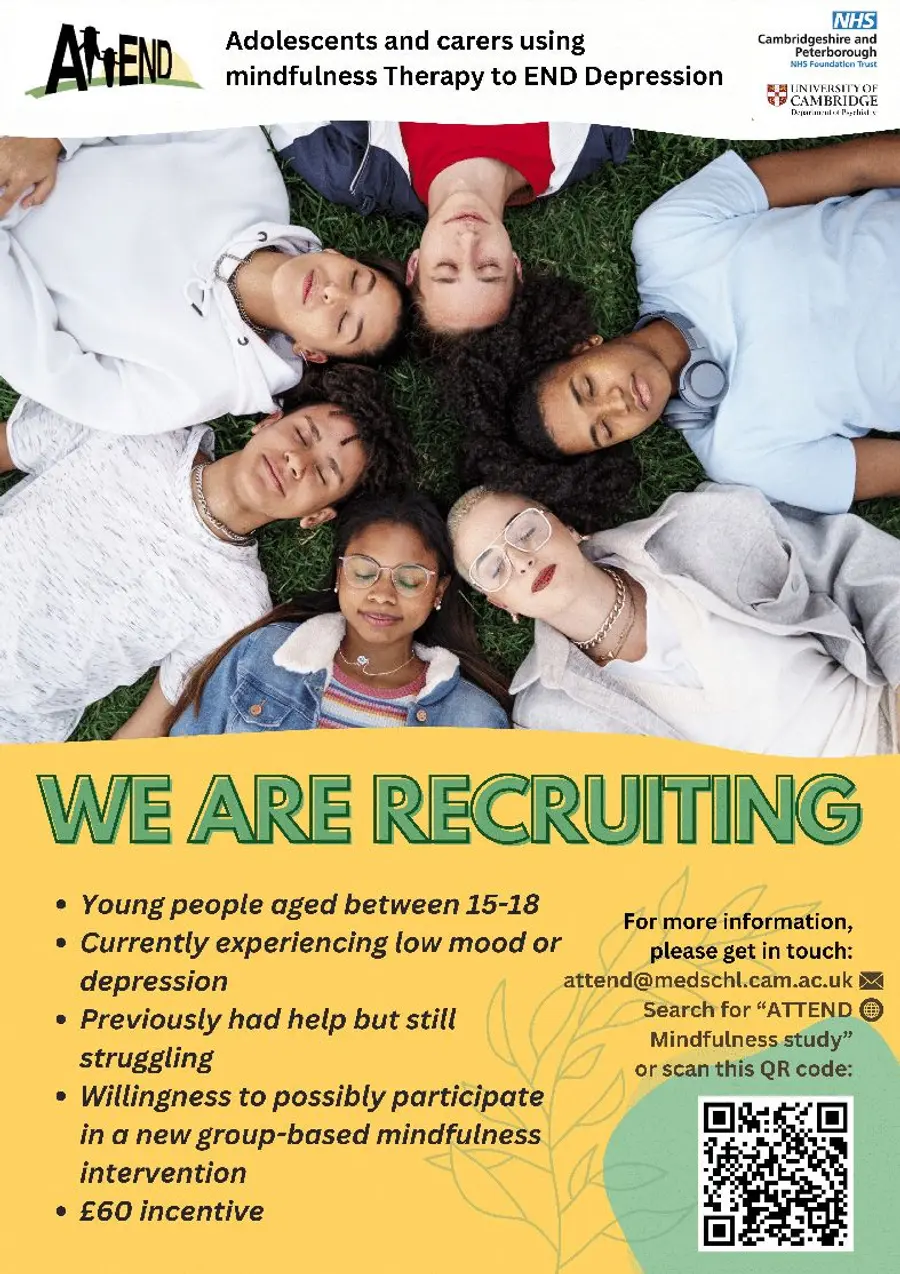
This trial is aimed specifically at these young people. It will include 15- to 18-year-olds who have completed at least one evidence-based course of treatment for depression or anxiety but still have depressive symptoms, or whose symptoms have worsened again. The researchers will randomly divide 480 participants into two groups: one will receive MAC alongside usual treatment, while the other will continue with usual treatment alone. Youth mental health services in London, Devon, Sussex, the East of England (Cambridge and Peterborough), Oxford and Nottingham are taking part, with funding from the National Institute for Health and Care Research (NIHR). Young people currently receiving intensive care for suicidal risk, self-harm or an eating disorder, or who have psychosis or post-traumatic stress disorder, are excluded.

Adapting adult mindfulness for teenagers, with a parents’ class in the next room
MAC is rooted in mindfulness-based cognitive therapy (MBCT). This group programme combines meditation practice with cognitive therapy to help people recognise the early signs of depression and learn to break out of repetitive thought patterns that can fuel it. The UK National Institute for Health and Care Excellence (NICE) recommends MBCT for adults with recurrent depression, but the researchers say it has not yet been properly tested with adolescents.
The researchers adapted the programme for teenagers. According to announcements from the University of Cambridge and King’s College London, MAC runs for eight weeks, with one in-person or online group session each week, lasting between 1 hour 30 minutes and 1 hour 45 minutes. Compared with the adult programme, it includes more movement breaks and shorter periods of skills practice. It also includes snacks and activities likely to appeal to teenagers. Between sessions, participants record their home practice in an app developed with families. A trained facilitator leads each group of 6–14 young people.
One notable feature is a separate programme for parents and carers. While the young people attend their sessions, parents take part in mindfulness sessions in another room. Their participation is optional, so teenagers can take part in the trial even if their parents do not wish to join. The researchers say that raising a teenager with depression is itself highly stressful and can strain family relationships; they also note that teenagers whose parents experience depression are more likely to have mental health problems as adults. Professor Patrick Smith of King’s College London, who is co-leading the study, said that parents often struggle because they do not know how to help their children, and that he hopes the parents’ programme will help them understand and support their child’s recovery.

Mood measured every fortnight for 12 months, alongside parents’ wellbeing
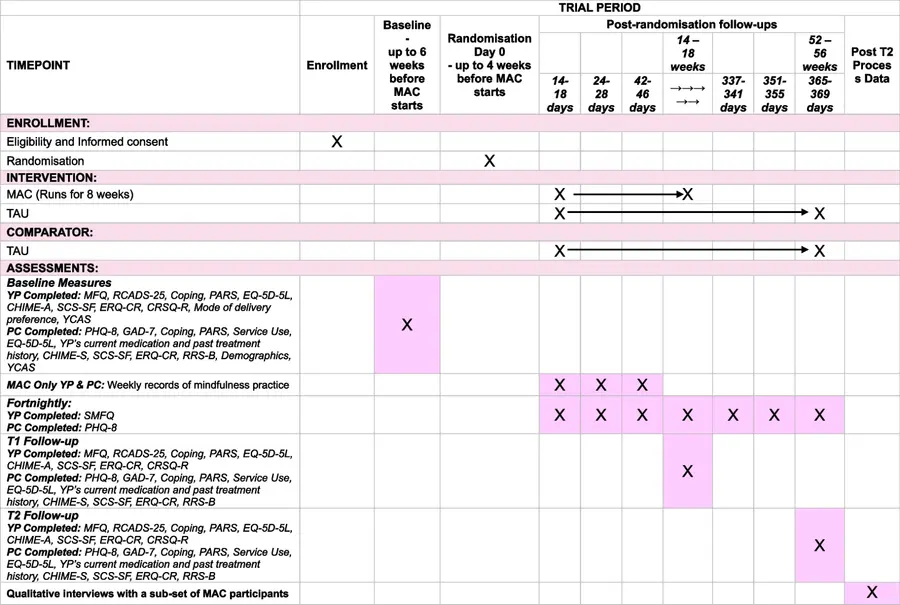
The trial has also defined in advance what it will count as an effect. Its primary measure is the Short Mood and Feelings Questionnaire (SMFQ), completed by the young people. Participants will fill it in every fortnight for 12 months after randomisation, allowing the researchers to compare not just scores at a single point, but how mild and how brief depression is over the course of a year in each group. That is because the programme aims to prevent depression from improving and then returning.
Parents will also complete the Patient Health Questionnaire (PHQ-8) every fortnight over the same period. At the start of the trial, around 14 weeks later and again at 12 months, both young people and parents will separately be assessed for anxiety, quality of life, ability to cope with life, and the quality of the parent–child relationship. The timetable in the study protocol also includes weekly records of mindfulness practice by MAC participants, as well as interviews with some participants after the programme ends. This will help the researchers examine who the programme works best for and how the amount of practice relates to the results.
The researchers will also assess costs. They will calculate the costs and benefits of adding MAC to usual treatment from the perspectives of healthcare and social care, education and society as a whole. The idea is that the programme would need to prove affordable for publicly funded healthcare, as well as effective, before it could be rolled out across the NHS. According to the trial registration, recruitment was scheduled to run from August 2024 to February 2026, with the study as a whole due to finish in September 2027.
The results are not in yet—but why study meditation with families?
This trial has not proved that mindfulness works. The results will take time, and they may not be what the researchers hope. The UK has already had such an experience. In a 2022 study published in the journal Evidence-Based Mental Health, Professor Willem Kuyken of the University of Oxford and colleagues examined 8,376 pupils aged 11–14 at 84 schools. The MYRIAD study found no evidence that mindfulness lessons delivered to all pupils at school improved mental health more than usual lessons. Professor Kuyken is also listed as an author of the ATTEND study protocol.
ATTEND takes a different approach. Rather than giving every child the same lessons, it selects young people who are still struggling despite treatment and adds mindfulness to their existing care. And rather than leaving the young person to practise alone, it seats their parents in the next room. Cat Nellist, who experienced an eight-week MBCT group at the age of 15 and now co-leads patient and public involvement in the study, told the University of Cambridge that the programme helped her deal with negative thoughts and improved her relationship with her parents.

For teenagers in South Korea, who give so much of their day to information and screens, the idea of meditation that means sitting still for a long time may feel remote from the outset. MAC’s longer movement breaks and shorter practice periods are worth noting as ways of making mindfulness more approachable. Its design also treats parents’ wellbeing alongside the child’s, rather than leaving a child’s mental health as a problem for them to solve alone—a useful reference for services in South Korea considering family-based mindfulness. However, the programme is designed to supplement professional treatment, not replace it. If a child is struggling with depression, consult a professional first; at home, a small practice in which parent and child each pay attention to their own breathing for even a few minutes a day could be a place to start. Healing News will be following what answer this UK trial delivers in 2027.

Enquiries about this article: fare3041@naver.com