


What might happen if, instead of urging people to stop gaming, we helped them notice and observe the moment the urge to play arises? A research team led by Professor Yoon Sungmin of the Department of Social Welfare at Sungkyunkwan University took this question into a study with Professor Willem Kuyken of the University of Oxford’s Oxford Mindfulness Centre. It was a pilot study involving 46 university students at high risk of internet gaming disorder. Sungkyunkwan University announced the findings on 10 July, and the paper had been published earlier, in May, in the international journal Mindfulness.
Mindfulness-based cognitive therapy, used to prevent depression relapses, adapted for gaming urges
The research team used mindfulness-based cognitive therapy (MBCT). They adapted this treatment, which has been used to prevent depression relapses, to the characteristics of gaming disorder and called it MBCT-G. Professor Kuyken, an MBCT researcher who leads the Oxford Mindfulness Centre, was a co-author of the study.
The programme had two main strands: mindfulness meditation, in which participants practised taking a step back and observing their feelings and thoughts when a strong urge to play arose; and cognitive therapy, which helped them change their patterns of thinking so they could respond differently without being swept up by the urge. Rather than trying to suppress the urge, the practice was about creating some space between the urge and oneself.
More than meditation: planning ways to find enjoyment outside gaming
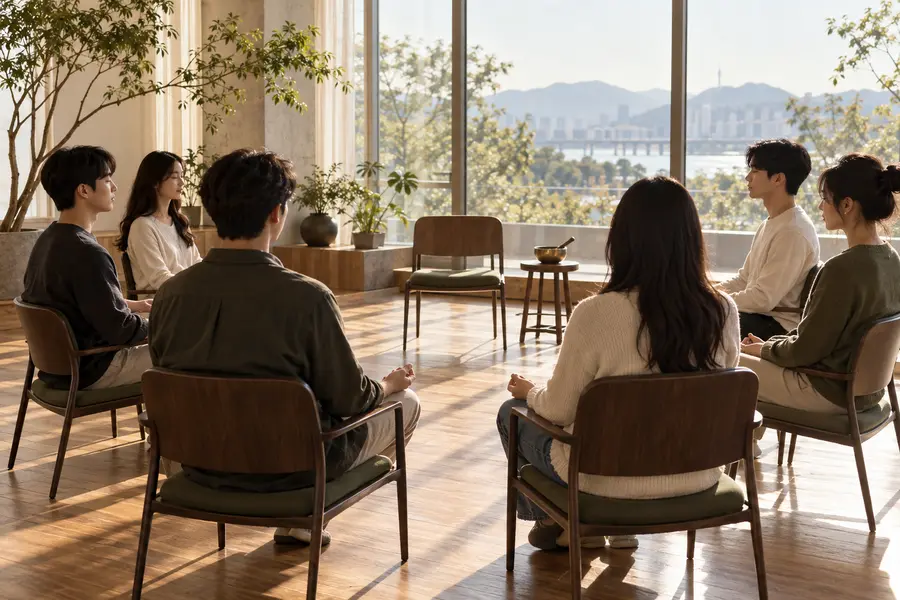
The course ran in weekly group sessions over eight weeks. According to the English-language press release, students learnt social skills and self-care techniques alongside mindfulness meditation each week. They also planned and tried out enjoyable alternatives to gaming, including physical activities such as exercise, social leisure activities, and creative hobbies.
The programme brought together time spent sitting and observing the breath with practical activities that involved moving the body in everyday life. For a generation accustomed to stimulation from screens, recommending meditation can make the prospect of sitting quietly seem daunting. When practice also involves the body, relationships and hobbies, meditation can become a tool for changing daily life.
Comparing 24 with 22, self-control was the gain that lasted a month
The research team gave MBCT-G to 24 of the 46 participants and placed the remaining 22 in a comparison group that received no programme. They measured symptoms of gaming disorder, impulsivity, depression, perceived stress, anxiety and self-control before and after the programme, and again four weeks after it ended.
According to the paper’s abstract, the programme group showed greater reductions than the comparison group in gaming disorder symptoms, perceived stress and state anxiety, and a greater increase in self-control. These changes continued at the four-week follow-up. However, the improvement in state anxiety was not maintained at four weeks. The abstract does not report separate results for impulsivity or depression, which were also measured.
In a departmental notice, Professor Yoon said the study could offer an evidence-based psychological intervention to help students break the vicious cycle of impulsively turning to games in response to academic stress. The English-language press release also suggested the programme could be rolled out in university counselling centres and gaming-overuse prevention centres, noting that its group format requires fewer clinical staff.
A 46-person pilot study: the researchers themselves say larger-scale testing is needed
These findings should be seen as a first step showing promise. The study had only 46 participants, and the comparison group received no intervention. Because the researchers did not compare participants with students taking part in another group activity for the same amount of time, it is difficult to tell whether the changes were due to mindfulness or to the experience of meeting as a group and receiving attention. The follow-up period was also short, at four weeks.
The research team also said in the paper’s conclusion that the findings need to be tested again with more participants, a comparison group taking part in a different activity and a longer follow-up period. Students experiencing gaming overuse, and their families, should see this study not as a definitive treatment answer but as one possible approach to try alongside professional counselling.
Meditation for an information-saturated generation: a question from Korean research in an international journal
The World Health Organization included gaming disorder in the International Classification of Diseases in 2019. In an age when the screen in our hands delivers a constant stream of stimulation, the ability to create distance from an urge is not a challenge only for some students who spend a lot of time gaming. Most people today are familiar with reaching for their phones as soon as a notification sounds.
The study is an example of Korean researchers designing research with South Korean university students and publishing the findings in an international journal alongside an Oxford researcher at the heart of mindfulness research. It was supported by a project to develop gaming-based digital therapeutics, funded by the Ministry of Culture, Sports and Tourism and the Korea Creative Content Agency. It is worth noting that South Korea is building an evidence base on whether meditation can move beyond temples and retreat centres into university counselling rooms and settings focused on preventing digital overuse.
Rather than being told to stop gaming, people may remember longer a prompt to notice what is arising within them in the moment. For those who find seated meditation unfamiliar, it may be helpful to start with activities that involve the body, such as walking, exercise or spending time with others. Practising a pause before an urge, in a way that suits you, is the starting point this study offers.
Press enquiries: fare3041@naver.com