

At the Edge of Summer, a Meditation Festival in the Middle of Seoul
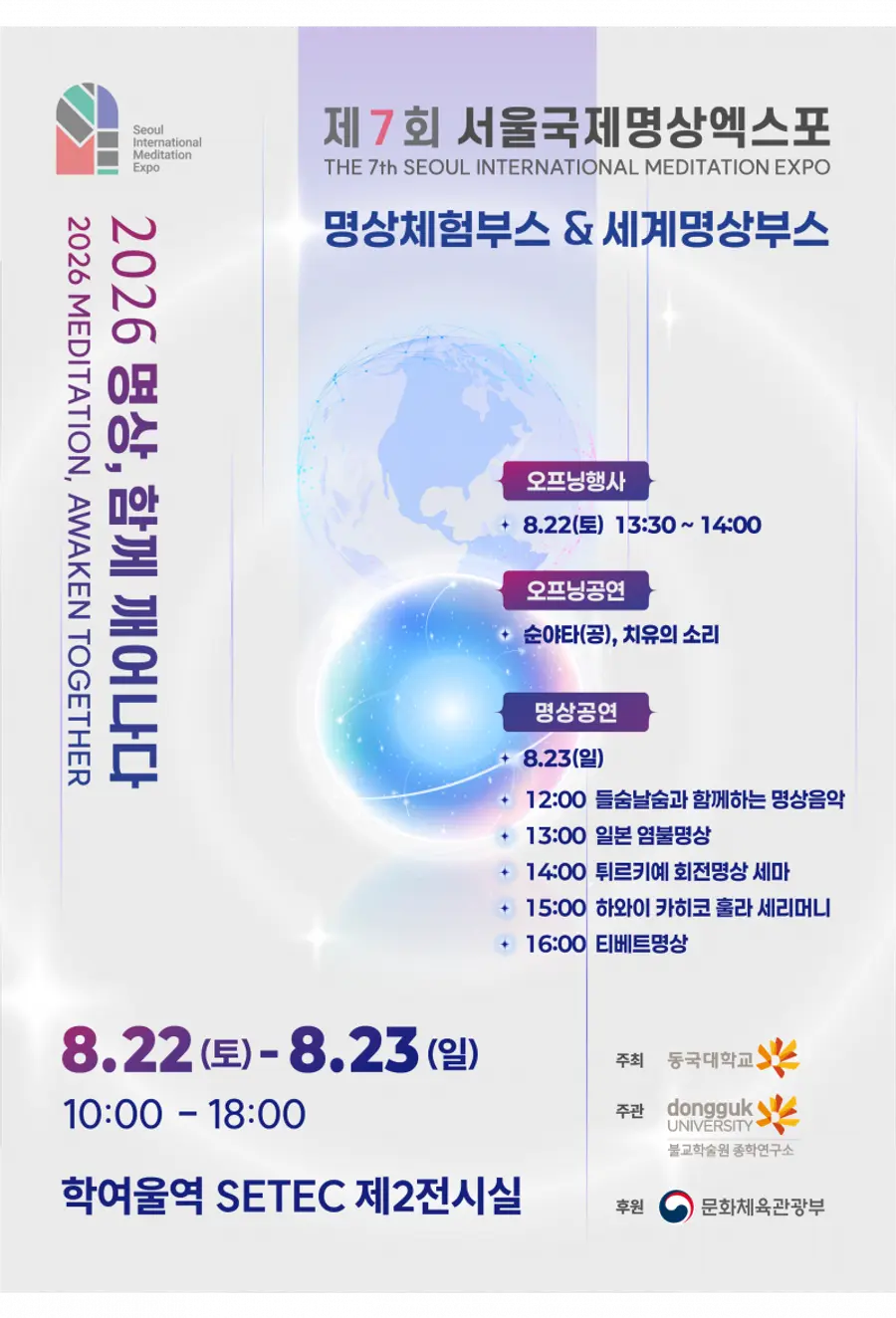
At the Gangnam Hakyeoul Station SETEC, the 7th Seoul International Meditation Expo, “Meditation 2026, Awaken Together,” opens its doors on Aug. 22.
It’s easy to think of meditation as something you do alone, but the power of practice becomes far clearer when people sit together. That’s why this year’s expo theme, “Awaken Together,” doesn’t read like just a slogan.
This expo is hosted by the Jonghak Research Institute at Dongguk University’s Buddhist Studies Research Institute, and it is sponsored by the Ministry of Culture, Sports and Tourism. From Aug. 22 to Sept. 18, it runs in four areas: experience, academics, education, and culture. This year, based on SETEC’s hall rental schedule, it switches the order from past years: the experiential events open first, followed by the academic program, the Meditation Conference, in September.
35 Booths From Home and Abroad, Meditation You Can Feel With Your Fingertips
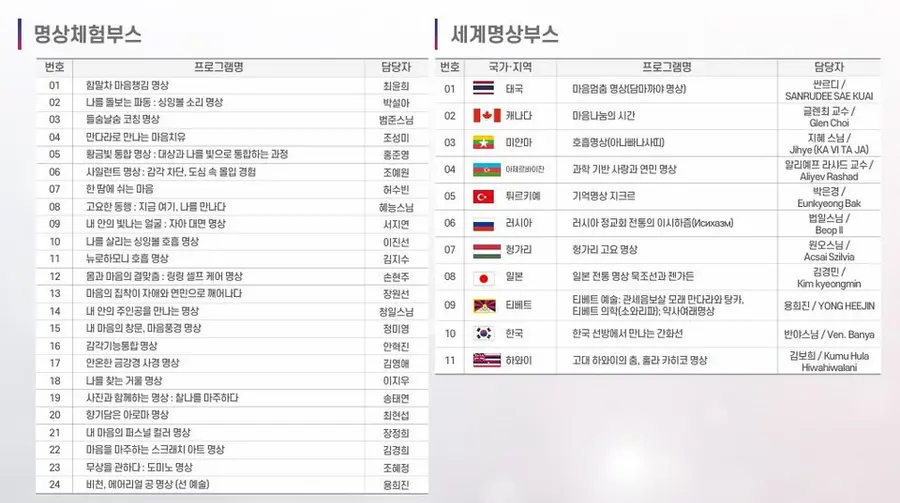
At the heart of the event are 35 meditation experience booths from inside and outside Korea. Twenty-four booths from Korea and booths from 11 countries are set side by side.
The meditation experience booths offer 24 programs, including breathing meditation, walking meditation, body awareness, mindfulness, meditation counseling, meditation using brain waves, and sunmyeongsang. All programs are designed for participants to try directly under the guidance of experts. There’s a bridge you can’t cross between meditation you read on the page and meditation you practice with your body, and the value of this expo lies in the fact that it lets people cross that bridge in a single day.
From Ganhwasen to Isihajum, Practice Traditions Crossing Borders
The world meditation booths are the most eye-catching spaces at this event. Alongside Korea’s ganhwaseon, participants can experience traditional meditation methods from 11 countries and practice methods that reinterpret them in a modern way in one place.
A portion of that lineup was previewed at a 기자간담회 held Aug. 10. During a session moderated by Professor Park Gyu-ri, Beomjun Sunim demonstrated Plum Village meditation songs and a “Deulsu-Nae-su” coaching meditation. The flow is to examine your current thoughts and emotions, notice your breathing, and then fill up with new energy through pebbles breathing meditation. Beomjun Sunim said that Ven. Thich Nhat Hanh valued the work of gathering community energy by practicing together with the monk who has always been at the side.
The Isihajum meditation rooted in Russian Orthodox tradition, introduced by Beopil Sunim, is also striking. Beopil Sunim said that while prayer methods may differ across religions, all meditation aims to settle a scattered mind, and that it resembles Buddhist gwanseon—meditation focused on a specific image—because both involve concentrating by imagining that image. Myanmar’s anapanasati meditation was also introduced.
The scene in which practices from different religions and cultures come together under a shared language—meditation—sends its own message. For those who want to choose a way of caring for the mind suited to their own lives, there are few opportunities more efficient than this.
The Opening Ceremony, Healing Sounds Opened by Gong and Beopgo
The opening ceremony takes place at 1:30 p.m. on Aug. 22. Two people, Yong Hee-jin and Kim Hye-jin, will present the healing sound of Sunyata (gong) using the gong and beopgo. If you’ve ever experienced what it feels like for sound to pass through your body, you’re urged not to miss this order.
The experience events run for two days, Aug. 22 and 23, from 10 a.m. to 5 p.m. Participants can join each program through advance registration, and if there are remaining seats, same-day on-site registration is also available. Welcome gifts are provided to all participants, and events are arranged through a drawing.
In September, a Conference Where Global Meditation Experts Gather
The academic program runs for two days starting Sept. 17 in Namsan Hall on the third floor of Dongguk University’s main building.
On the first day, the theme is “Sunmyeongsang in the Age of Technoscience.” Dongguk University Distinguished Professor Subul Sunim, Minas Kapahtos Chapman University Professor, Sasaki Shizuka Honamono University Honorary Professor, and Yuki-jun Sangji University Honorary Professor will participate to examine the reflective meaning and practical value of sunmyeongsang.
The theme for the second day, Sept. 18, is “The Wellness Value of Sunmyeongsang.” Yongta Sunim, chairperson of the Happy Village Foundation’s board of directors; Rashad Aliev, an assistant professor at Azerbaijan ADA University and also the director of the Innovation Center; Tupten Tendhar, director of the Nonviolence Summer Institute at the University of Rhode Island in the United States; and An Hee-young, head of the Korea MBSR Mindfulness Research Institute, will introduce modern ways to apply meditation. It’s a session worth recommending for those who want to see meditation translated into the language of wellness beyond the boundaries of religion.
That same day at 4:30 p.m., a sunmyeongsang concert is held in Namsan Hall. Fusion performances and modern meditation music—something people of all ages can enjoy together—take the stage.
The Final Year of a Three-Year Study, Meditation Read Through Brain Waves
The education track is also quietly building results. The Buddhist meditation program development project that has been underway since last July has entered the final stage of a three-year research assignment. In the first year, it published papers listed in KCI, and in the second year, it proposed policy applications. This year, the goals are to present papers that analyze pre- and post-changes in participants’ brain waves and to complete a three-stage Buddhist meditation education program called “Happy Awakening.”
Meditation routine content—3 to 5 minutes long that people can follow in daily life such as sitting, standing, and walking—will also be produced and distributed as short videos. While the bar of “three minutes a day” may seem low, the project is seen as one of the most practical attempts to achieve the goal of making meditation more mainstream.
Why Meditation, Now?
The Jonghak Research Institute cited the growing need for mental health and self-care in modern society as the backdrop for this expo. As digitalization and commercialization advance rapidly and people become increasingly individualized, the institute said it’s judging that more people are being exposed to stress and psychological pain.
The Jonghak Research Institute said it has developed and spread a variety of modern meditation methods to manage citizens’ stress and strengthen psychological resilience based on traditional Buddhist practice methods. It added that it has taken the lead in making meditation mainstream and global by expanding popular, modern meditation wellness content.
Jungdoe Sunim, head of the Jonghak Research Institute, said he set three goals—globalizing, living with, and popularizing meditation—and that he has prepared and kept refining them, adding that many people worked hard and researched to reach the seven-year mark.
Seven years is long enough for a single event to run on inertia. Still, when you look closely at this year’s program lineup, you see new attempts layered in. Brain-wave measurement, comparative experience of practice traditions from 11 countries, and even three-minute daily meditation videos. The direction is clear: bringing meditation from the “special” work of special people into everyone’s everyday life.
Participant Information
Advance registration for the 7th Seoul International Meditation Expo is available through the official website (mind.dongguk.edu) and the official Instagram. The opening of the meditation experience booths, the meditation conference, and the sunmyeongsang concert are streamed in real time via the official YouTube channel of the Seoul International Meditation Expo and BBS YouTube.
Related information : https://mind.dongguk.edu/front/