

The first question facing anyone who wants to start meditating is: which kind of meditation should I try? Some practices involve counting the breath; others ask, “Who am I?” A research team led by Céline Stinus of the University of Navarra in Spain and Professor Sophie Berjot of the University of Reims Champagne-Ardenne in France put these two approaches to the test side by side. Both reduced depressive symptoms within four weeks, the results showed, but through different pathways. The study was published in the journal Mindfulness and covered by US psychology news site PsyPost on 17 October.

147 people split into three groups for a four-week trial: 20 minutes a day, five days a week
The research team recruited 147 adults in France with little or no meditation experience. People taking psychiatric medication or with a history of a psychiatric diagnosis, such as depression, were excluded. Participants were randomly assigned to one of three groups. The first practised focused-attention meditation: concentrating on a single object, such as the breath, and returning to it when the mind wandered. The second practised self-inquiry meditation, examining their thoughts, beliefs and sense of self. It was a secular programme, with Buddhist doctrine left out. The third group was put on a waiting list and would learn to meditate after the study ended.
Over four weeks, the two meditation groups attended five 60-minute online group classes and practised alone for 20 minutes a day, five days a week. Participants in the meditation groups were not told which approach they had been assigned to. The research team expected self-inquiry meditation, which directly examines the mind and sense of self, to have a stronger effect.
Focused-attention meditation helped people step back from their thoughts; self-inquiry fostered a sense of connection with people and nature
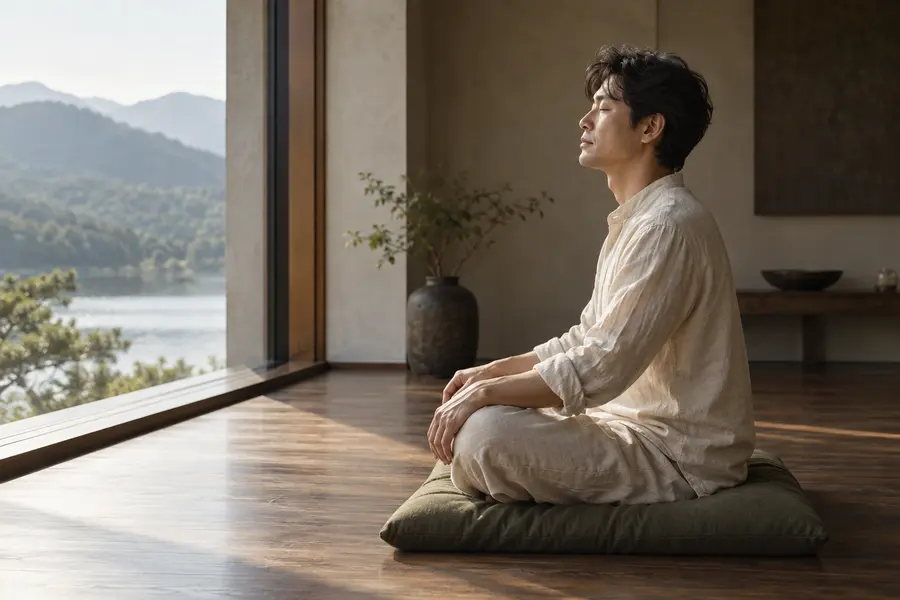
The results were not what the researchers expected. Both meditation groups saw greater reductions in depressive symptoms and feelings of identity threat than the waiting-list group, with no clear difference between the two forms of meditation. Identity threat refers to the extent to which a person feels that their sense of who they are is being shaken. Rigid beliefs that lead people to be hard on themselves declined only in the focused-attention group.
The difference lay in how the changes came about. In the focused-attention group, depressive symptoms fell as participants became better able to see thoughts as passing events in the mind, rather than as part of who they are. Psychologists call this ability decentering. In the self-inquiry group, feelings of connection with humanity and nature increased from before the meditation programme; greater connection with humanity was associated with a partial reduction in identity threat. However, the change in connectedness was not statistically clear compared with the waiting-list group, and the researchers said it should be interpreted cautiously because the analysis was exploratory. The researchers found no factor in their measurements that explained the reduction in depression in the self-inquiry group. They concluded that the two forms of meditation had similar effects on depression but worked through “partly different mechanisms”.
Twenty people left the waiting-list group, compared with four or five in each meditation group: the limitations behind the numbers
There are several other points to bear in mind when reading the study. Twenty people dropped out of the waiting-list group, compared with four or five in each meditation group. Participants in the waiting-list group knew they were not receiving anything. None of the participants had been diagnosed with depression, and their depression scores were within the normal range. This means the same results cannot be assumed to apply to people with depression.
Both programmes were taught by the paper’s first author, so the instructor’s influence may have played a part. All outcomes were measured through self-reports; the study plan was not registered in advance, and there was no long-term follow-up. Most participants were women, and as they had volunteered for a meditation study, they may have been favourably disposed towards meditation.
For people with busy minds and those who feel lonely, the same meditation may not suit everyone

The study has a clear message for people choosing a meditation practice: rather than seeking a definitive answer about which one is better, start by asking what kind of change you need. For someone whose day slips away as they get caught up in their thoughts, focused-attention meditation, with its emphasis on the breath, may help create space between the self and those thoughts. For someone whose sense of who they are feels shaky, or who feels cut off from other people, looking inward may help restore a sense of connection.
Practices that ask “Who am I?” are also deeply rooted in Korean meditation. Seon practice, for example, involves holding a hwadu such as “What is this?” Although the self-inquiry meditation in this study was a secular programme, the fact that Western laboratories are beginning to test meditation practices that examine the idea of the self in scientific terms is opening up new ways for Korean meditation to engage with the world.
Beginners may find it helpful to try both approaches rather than treating one as the right answer. If sitting and focusing on the breath feels frustrating, they could start with focused-attention meditation that follows the body’s rhythm, such as walking meditation. Taking time to write down thoughts and ask questions about oneself can also be a small first step towards self-inquiry. Meditation is not a substitute for treatment for depression; if low mood persists, seeking professional help should come first.
For enquiries: fare3041@naver.com