


Meditation sessions are getting shorter and moving into devices and apps. At the same time, more people are asking anew about the role of teachers and the meaning of tradition. Here are eight brief updates from the international meditation scene in the second and third weeks of October.
Even 30 seconds waiting for the microwave can be a practice: psychologist Eli Sussman’s micropractices
US broadcaster CNBC featured psychologist Eli Sussman’s new book, Micropractice, on 20 October. The book brings together short practices that take no more than 30 seconds. Those featured in the article include 30 seconds of improvised dancing, silently wishing well to people encountered throughout the day as a daily loving-kindness practice, and trying to celebrate someone else’s happiness when jealousy arises. Sussman said consistency matters more than practising for a long time, and pointed to waiting for the microwave or standing at traffic lights as opportunities to practise.
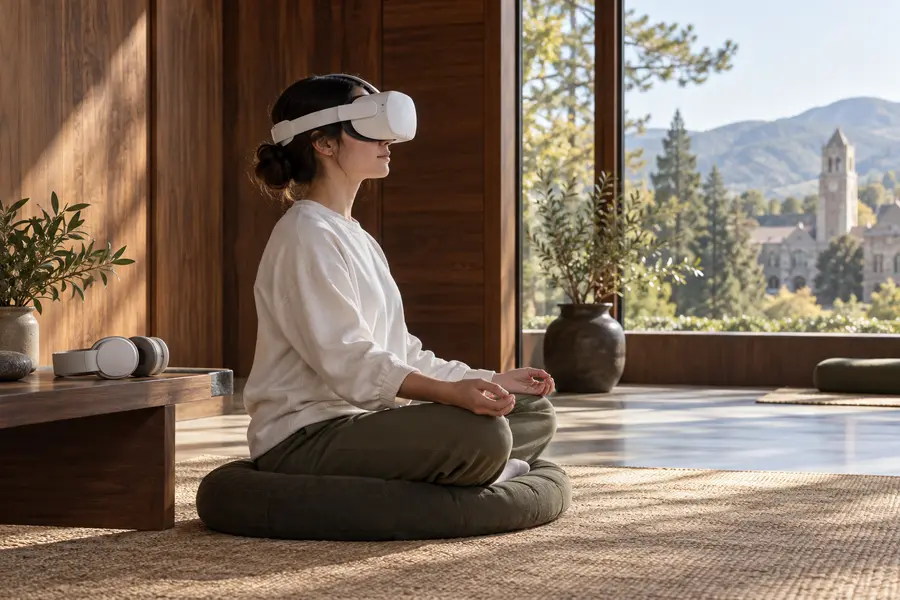
Students using VR headsets visited the meditation room more often; anxiety scores halved in both groups
Researchers at the Louisiana State University Health Sciences Center in Shreveport published a preliminary study in the journal Frontiers in Digital Health on 12 October. They divided 22 healthcare students with anxiety scores above a set threshold into two groups: one practised VR meditation and the other listened to audio meditation. For eight weeks, both groups were asked to practise in a campus meditation room for about 10 minutes at a time, at least twice a week. The VR group completed an average of 75% of the recommended sessions, compared with 53% in the audio group, and anxiety scores fell by nearly half in both groups. The researchers said that, because there was no control group that did nothing, the change could not be attributed definitively to meditation, and no difference emerged between the two methods.
An app for students anxious about studying: Caldo combines mindfulness with personalised learning
US-based Yellow Lion Leaders announced the launch of Caldo, an app for students, in a press release on 21 October. Designed for students experiencing anxiety, it combines mindfulness with adaptive learning that adjusts to each learner’s level. It is a sign that the separate worlds of study apps and meditation apps are coming together on a single screen.
Is non-judgemental awareness alone enough? A review of 120 papers explores four dimensions of Buddhist mindfulness
The international journal Mindfulness published a paper in October revisiting the meaning of mindfulness. The scoping review, published online on 3 October, analysed 120 papers comparing modern mindfulness with Buddhist mindfulness. The researchers concluded that the literature portrays Buddhist mindfulness as directed towards ethical living and personal transformation, informed by wise judgement, inseparable from other practices, and as an alertness that guards the mind without losing sight of one’s intentions. They also proposed a four-stage model of mindfulness, bringing the two perspectives together as complementary rather than opposing ones. The same month saw the publication of a study on brain connectivity in a self-paced, recorded MBSR (mindfulness-based stress reduction) programme, as well as a randomised controlled trial of behavioural strategies for making meditation apps a habit.
The issue is not meditation’s dark side but unguided practice: Tibetan teacher Anam Thubten’s response
Anam Thubten Rinpoche, who practises in the Tibetan Nyingma tradition and leads the Dharmata Foundation in the US, published an article on 8 October in Buddhist media outlet Buddhistdoor Global, challenging the phrase “the dark side of mindfulness”. While acknowledging that some people have difficult experiences during practice, he argued that the problem lies less in mindfulness itself than in how it is taught and the lack of guidance. He likened it to calling walking’s dark side the fact that some people sprain an ankle while walking. In traditional settings, qualified teachers assessed practitioners’ readiness, he said; today, with mindfulness commercialised, it is hard to know who is teaching and how.
Esalen and Tassajara were evacuated too: Big Sur retreat centres weather landslides and wildfires
US religion news service Religion News Service reported on 21 October on how spiritual centres in Big Sur, California, are coping with climate disasters. Big Sur’s coastal highway, cut off for nearly three years after successive landslides in 2023 and 2024, reopened in January 2026. But wildfires in August prompted evacuation orders for the Esalen Institute, which helped introduce yoga, breathwork and meditation to the West; the Catholic New Camaldoli Hermitage; and Tassajara Zen Mountain Center. With El Niño raising fears of heavy winter rain and further landslides, New Camaldoli Hermitage decided to close for the winter, and its future was reported to be uncertain.
Meditation, discussion and visits to the field: a two-week young bodhisattva programme in Taiwan
The International Network of Engaged Buddhists (INEB) is holding an international young bodhisattva programme in Taiwan from 21 October to 3 November. Run in partnership with Hongseo Buddhist Academy, the programme includes meditation, discussion and community activities, as well as visits to civil society organisations, government agencies and Buddhist institutions. It is aimed at young people aged 20 to 40, and non-Buddhists are welcome. The programme reflects the engaged Buddhist aim of connecting meditation not only with personal peace but also with the power to bring about social change.
Seven nights for 7,000 baht: a November mindfulness week at Thai Plum Village
Thai Plum Village International Practice Centre, which carries on the tradition of Zen Master Thich Nhat Hanh’s Plum Village, is holding a mindfulness week retreat from 20 to 27 November. The centre is in Pak Chong, Nakhon Ratchasima province, and has capacity for 150 people. Sessions will be conducted in Vietnamese, English and Thai. Accommodation and meals for seven nights cost 7,000 baht per person. Anyone aged five or over may attend, but those under 18 must be accompanied by a guardian. Registration opened online on 25 August and will close when the retreat is full.
Between shorter practices and deeper questions
Thirty-second practices, VR meditation rooms and mindfulness in study apps are lowering the barrier to meditation. They offer a welcome starting point for people who find it difficult to sit for long periods. In the same week, a Tibetan teacher warned against unguided practice, while an academic journal revisited the original meaning of mindfulness. Starting simply, then taking things one step at a time with the help of a trusted teacher and community, is a useful principle to keep in mind when choosing a practice that suits you.
Enquiries about this article: fare3041@naver.com